S9 Observer
What S9 does
S9 is the mother-analyzer. The systems before it hold the desk’s open data with as few assumptions as I could manage. S9 is where I imagine: it puts the systems together into flows of people, and only then compares those flows with what the city counted and with space syntax.
Imagining needs rules, and S9 writes every one of them in a ledger with its source, or marks it as an assumption. It builds several rival readings, each changing a single rule, so a difference between them points at that rule. No reading is tuned to the counts or to space syntax, and a test checks this by scrambling both and finding that nothing moves.
S9 grows in slices. The first is a weekday morning on foot.
The first slice: a weekday morning on foot
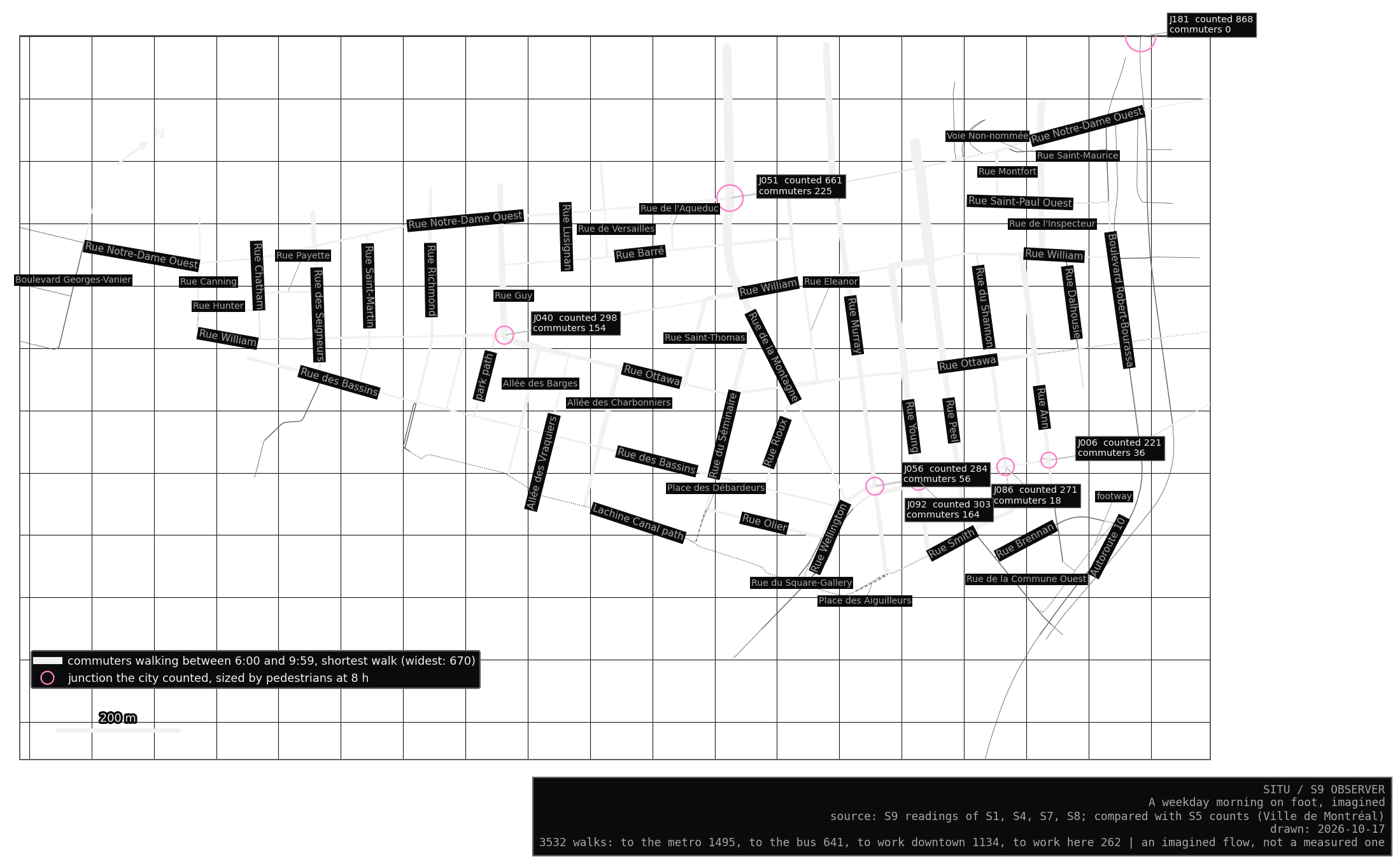
Between 6 and 10 h, S9 sends four kinds of walker across the S1 streets:
| Who | From | To | People |
|---|---|---|---|
| residents who walk to work outside the area | home (S7) | Place Ville Marie, through the door that makes the walk shortest | 1,134 |
| residents who walk to work inside it | home | a building with business premises (S4) | 262 |
| residents who ride | home | the nearest metro entrance or bus stop | 1,069 |
| workers who ride in | the entrance or stop nearest their workplace | the workplace | 1,067 |
That makes about 3,500 walks, the most of them (about 1,500) between 8 and 9 h. Three readings route them:
- shortest: the shortest walk.
- open: enclosed streets feel longer, by up to half, using the area seen from S8.
- straight: the route with the fewest degrees of turning, which Hillier and Iida (2005) found fits observed movement in London better than the shortest one.
What it found
commuters account for about a quarter of the pedestrians counted at 7 and 8 h · the busiest counted junction gets none of them
Across the seven counted junctions, S9’s commuters pass 22 to 27 % of the pedestrians counted, whichever reading routes them (certain, for these rules). The rest are people this slice does not hold: errands, school runs, dog walks, visitors and people crossing from beyond the area. The counts give the size of that gap; the next slices of S9 will try to fill it.
The busiest counted junction, Robert-Bourassa at Saint-Jacques, saw 868 pedestrians at 8 h, and no commuter of S9 passes there in any reading or any stress test. It lies just north of the area, beyond the doors that S9’s walkers take towards downtown and the metro. Whoever walks there comes from outside this slice: probably from Old Montréal or from beyond the area to the east (guessing). It is the clearest question this slice raises, and it is listed as a checkpoint.
Where the commuters do pass, they explain more: half to three quarters of the count at Guy and Ottawa, the one junction counted on three days, and a third to a half at de la Montagne and Notre-Dame, the road to Lucien-L’Allier and Bonaventure.
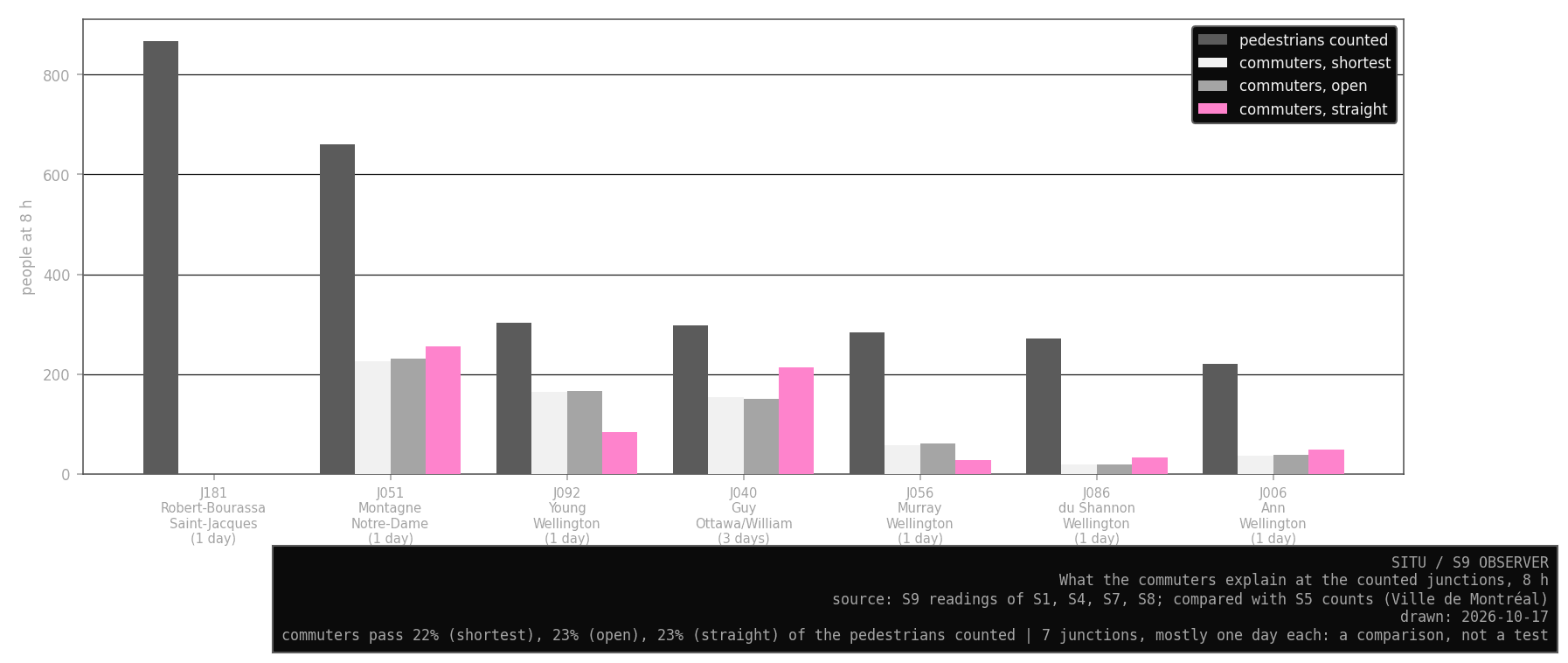
The four junctions on Wellington were counted on the same February morning. The counts there are even, from 221 to 303 pedestrians at 8 h. The shortest routes crowd the commuters onto Rue Young (164) and leave Rue du Shannon almost empty (18), a ninefold spread; the fewest-turns routes spread them out to a threefold one. Four junctions on one day settle nothing, so I read this as a lead: walkers here may use the parallel streets more evenly than the shortest walk predicts (likely, as a lead).
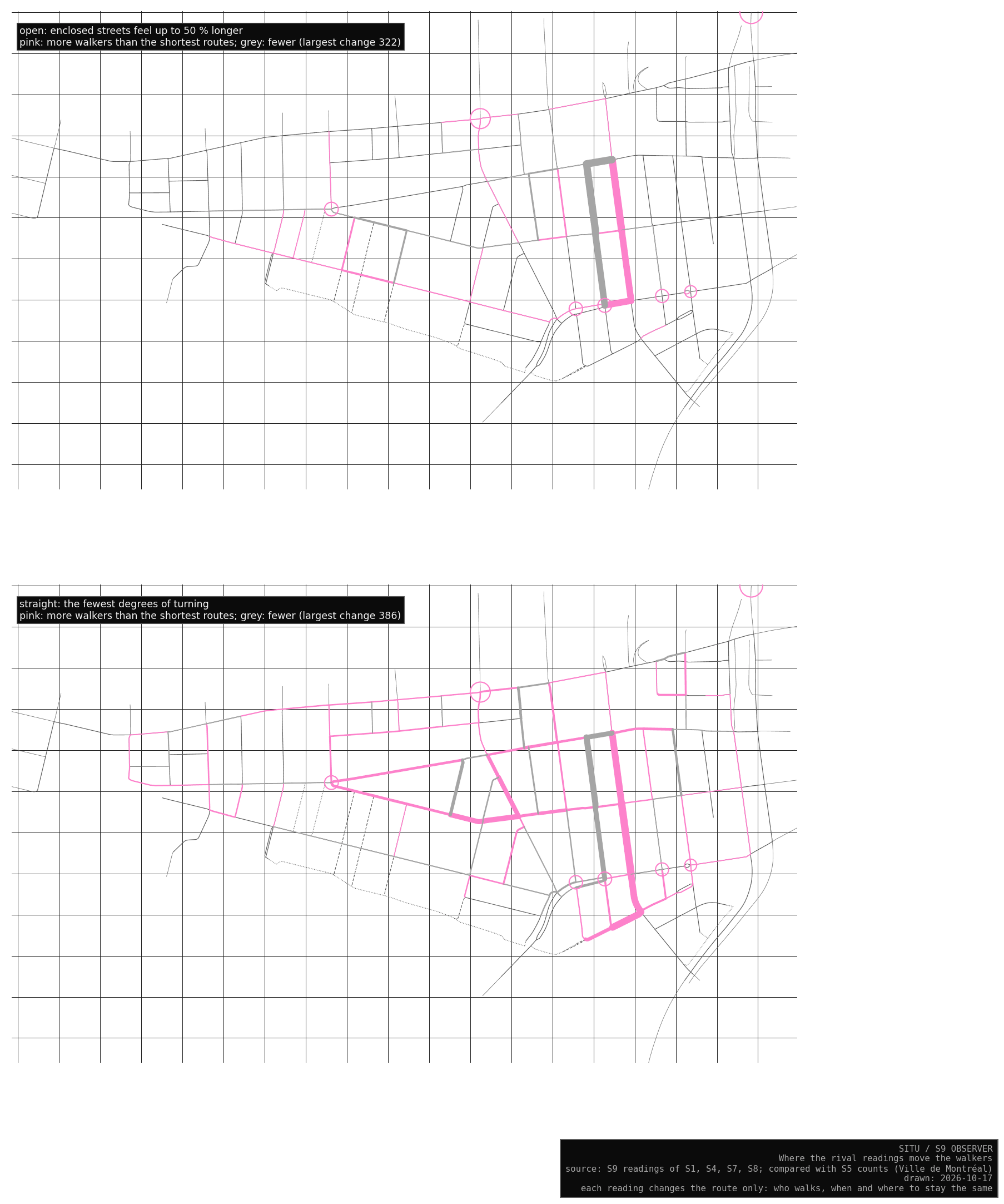
The reading “open” changes the route of 13 % of the walkers, mostly from Rue Young to Rue Peel, which is more open, and it adds three metres to the median walk. The reading “straight” changes 34 % and sends some on long detours: 15 % of the walkers go more than a quarter further than they need to. In a grid this tight, the view matters little to a commuter’s route, and a pure count of turns sends walkers further than people would plausibly accept.
Against space syntax, the morning’s flows agree only weakly with walking choice: rank correlation 0.24 for the shortest routes and 0.29 for the fewest turns (certain, as computed). Choice counts every route between every pair of streets. The morning sends everyone towards a few doors and stations, so the flows bunch on Peel and de la Montagne where choice is spread out.
My reading, and it is an interpretation: in the morning, Griffintown’s streets carry commuters mostly as a route out, towards the stations and downtown, and the larger part of the pedestrians counted are doing something else.
What it rests on
Everything above stands on the ledger: five pieces of evidence and twelve assumptions. The ones that move the results most are where walkers to work outside the area go (A01), how many resident walkers work inside it (A02) and which stop riders choose (A04). The stress tests move each of them.
The counts are thin: seven junctions, six of them counted on a single day, four of them on Wellington on the same day in February 2024. They can show where the imagined morning falls short; they cannot rank the readings, and S9 does not try.
Checkpoints
Two. People arrive to work in the small part of tract 4620071.00 inside the area, and S4 lists no building with business premises there. And nobody in S9 walks through Robert-Bourassa at Saint-Jacques, the busiest junction counted.
In the Lab
In the Lab, the Observer tab draws the morning’s walkers under each reading and hour, with each counted junction labelled with commuters against pedestrians counted. Click a street for its walkers by reading and hour, or a counted junction for the comparison. The side holds the whole ledger.